What Does Research Suggest About Unexplained Infertility and Egg Quality?
August 1, 2025

August 1, 2025
Mumbai is a city where life moves quickly and personal milestones often get pushed back. Many couples here begin trying for a pregnancy in their mid to late thirties, only to face losses they did not expect. Recurrent miscarriage is becoming more common in urban settings like this one, and factors like delayed conception, chronic stress, and immune irregularities all play a role. What makes it harder is that most couples arrive after already completing IVF cycles, running every standard test, and still not having a clear answer.
That is where we come in. At ICPRM, our focus is specifically on the immune-related causes of repeated pregnancy loss. We work with couples who have been through the cycle of loss and investigation and still do not know why it keeps happening. With a centre having the best recurrent pregnancy loss specialist in Mumbai, our approach looks at what standard fertility panels typically miss: the immune system's role in whether a pregnancy continues or not.
Mumbai's work culture has made delayed parenthood the norm rather than the exception. When conception is attempted in the mid-thirties or later, the risk of chromosomal abnormalities in embryos increases, as does the likelihood of implantation failure and early pregnancy loss. A study at a Mumbai government ART centre found that most patients sought fertility care only after five to ten years of marriage, with a pregnancy rate of just 8.3 percent, showing how long the road to diagnosis can be.
Alongside age, immune dysfunction is a cause that rarely gets investigated early on. PCOS, which is prevalent among women in urban India, has documented links to immune irregularities. High cortisol from prolonged stress can alter the body's inflammatory responses. These factors, often present together in Mumbai's fast-paced environment, can quietly undermine a pregnancy even when everything else appears normal on paper.
Every pregnancy requires the maternal immune system to do something quite specific: accept an embryo that carries the father's genetic material. That embryo is, immunologically speaking, partially foreign to the mother's body. In a healthy pregnancy, the immune system adapts and creates a tolerance that allows the pregnancy to continue. When that process does not work properly, the body may treat the embryo as a threat and respond accordingly.
Research has identified that many patients with recurrent pregnancy loss show measurable signs of immune dysregulation, including elevated natural killer cell activity, cytokine imbalance, and abnormal inflammatory responses. These do not show up on standard miscarriage panels. So couples walk away with "normal" results while the actual cause remains undetected and unaddressed.
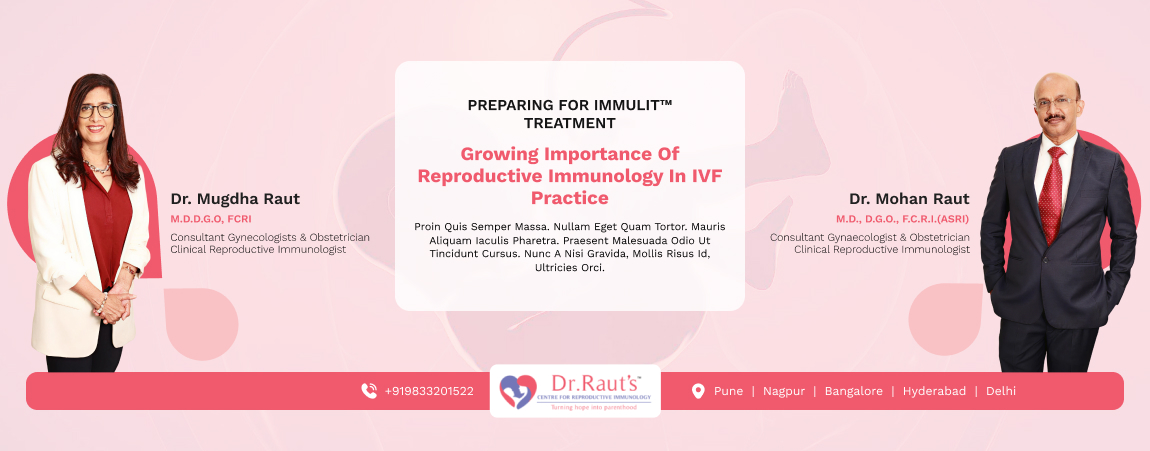
Our clinical focus at ICPRM is on cases where the immune system is the missing piece of the puzzle. Dr. Mugdha Raut and Dr. Mohan Raut, both Consultant Gynaecologists and Clinical Reproductive Immunologists, lead this evaluation with a focus on finding a specific and treatable cause.
Our specialized treatment for this is ImmuLIT®, a patented form of Lymphocyte Immunization Therapy. It works by using the father's lymphocytes to help train the maternal immune system to recognize and sustain the pregnancy rather than reject it. ImmuLIT® is completed in a single sitting of approximately three hours and is designed for couples dealing with recurrent miscarriage, repeated IVF failure, recurrent implantation failure, and unexplained infertility. Among appropriate candidates who complete the full protocol, we see an 80% success rate.
Our process is structured to be simple and manageable, even for couples who have already been through a great deal.
Most couples who find us have already done the work. They have completed IVF, consulted multiple specialists, and received reports that show nothing wrong. What they have not yet had is an evaluation focused specifically on immune function. We are located in Vakola, Santacruz East, which makes us accessible for patients coming from Bandra, Andheri, Kurla, Chembur, BKC, and other parts of Mumbai. For those who cannot visit immediately, the process begins online.
What we offer is not a repeat of what couples have already been through. Our scope is deliberately narrow: recurrent miscarriage, implantation failure, and immune-related fertility challenges. As experienced miscarriage doctors in Mumbai, we are not a general IVF clinic adding immunology as a side offering. This is all we do, and that focus makes a clinical difference for patients whose cases have not responded to standard treatment.
1. When is miscarriage considered recurrent?
Two or more pregnancy losses are generally considered recurrent, and at that point a proper investigation is warranted. Many couples wait longer before seeking specialized help, which can delay finding the actual cause.
2. Can immune issues cause repeated miscarriage?
Yes. When the maternal immune system fails to develop tolerance toward the embryo, it can trigger a response that ends the pregnancy. This is a well-documented cause of recurrent loss that standard panels do not routinely check for.
3. What tests are done for recurrent miscarriage at ICPRM?
We run immune-specific investigations including natural killer cell activity, cytokine profiling, and other inflammatory markers. These go beyond the chromosomal and hormonal tests typically offered at general fertility clinics.
4. What is ImmuLIT®?
ImmuLIT is our patented Lymphocyte Immunization Therapy. It uses the father's lymphocytes to help the mother's immune system build tolerance toward the pregnancy. The procedure is completed in a single clinical session of around three hours.
5. Is ImmuLIT® painful?
The procedure is minimally invasive and most patients manage it comfortably. Our team explains exactly what to expect before the session begins, so there are no surprises on the day.
6. Can miscarriage happen even when embryos appear healthy?
Yes, and this is one of the more frustrating experiences couples face. A structurally normal embryo can still fail if the immune environment is not supportive of implantation and early development. Embryo quality is only one part of the picture.
7. What makes ICPRM different from an IVF clinic?
IVF clinics focus on fertilization and embryo transfer. We focus on why pregnancies are not continuing after that point. Our entire clinical scope is built around immune-related causes of repeated failure, which is a different and more specific kind of care.

M.D.D.G.O, FCRI
Consultant Gynaecologist & Obstetrician
Clinical Reproductive Immunologist

M.D., D.G.O., F.C.R.I.(ASRI)
Consultant Gynaecologist & Obstetrician
Clinical Reproductive Immunologist